


The journey to bring Great Western Hospitals’ medics onto e-rostering

Great Western Hospitals NHS Foundation Trust consists of one acute hospital (Great Western Hospital) and community services that run across Swindon and Wiltshire. And community services that run across Swindon and Wiltshire. The Trust employs over 5,500 staff, has 450 acute beds and oversees an average of 1.2m patient contacts every year.
Although the Trust had moved the majority of its Agenda for Change workforce over to digital rostering with Optima, medics were still relying on spreadsheets to manage their rotas and leave scheduling. This was a significant barrier to greater consistency and transparency in workforce management.
Trust leaders wanted to invest in extending full digital rostering capabilities to its medic workforce, with the aim of improving rostering across the entire organisation. A plan to extend e-rostering was put into action in March 2022, starting with teams working in obstetrics and gynaecology, before a wider roll out.
The result was that all rosters that formed part of the project scope were dual running across legacy systems and Optima by 31 October 2023 and all went fully live from 31 March 2024. Alongside the implementation of the system itself, the Trust created a group of dedicated Admin Roster Co-ordinators to decrease the amount of time medics were spending on managing.
The challenge
The rosters for most of Great Western Hospitals’ Agenda for Change staff were moved onto Optima in March 2018. While this streamlined the process of rostering and managing leave for a great deal of medical staff, alongside improving oversight of on-call shifts, medics within the organisation were still relying on spreadsheets to manage their rostering.
“One of the biggest drivers for moving rostering for medics over to an electronic system was that everyone had their own Excel spreadsheets on their own computer drives. That meant that it was difficult to have the consistency and transparency needed for effective workforce planning. Having medics’ rostering on a digital system would bring it in line with our Agenda for Change staff.”
Deborah Tapley
Workforce Systems Manager, Great Western Hospital
As part of the drive to strengthen oversight and transparency in rostering, the Trust wanted to accompany the expansion of Optima within its workforce with the introduction of Admin Roster Co-ordinators. These new roles, set to be based in each division, would offer valuable support to clinicians, who frequently noted the amount of time it would take them to manage their shifts and work schedules.
The Trust employs over 5,500 staff, has 450 acute beds and oversees an average of 1.2m patient contacts every year.
The solution
The Medical Rostering project team had a timeframe of between 18-24 months to complete an effective transition of all relevant medical divisions onto the digital system. To ensure an effective implementation, the team convened a monthly oversight group with involvement from the executive leadership team. The project team also drew up a medical rostering policy after extensive consultation with staff and their workforce representatives.
The team, which included three whole time equivalents to support the implementation, worked in partnership with RLDatix to prepare the first stage of the expanded implementation, which saw them build the obstetrics and gynaecology rosters. This experience would inform future parts of the implementation project and began a process that saw usage and performance metrics sent out to the trust’s executive leadership and divisional directors to give reassurance that the project was on track.

Deborah and her colleagues put in place a monthly oversight group to both review progress and act as a forum for the trust’s divisions to report and feedback on developments. The oversight group included members of Great Western Hospitals’ executive team, ensuring that the implementation was treated as a key priority for the organisation.
Admin Roster Co-ordinator roles were created to assist medics and relevant staff in managing work schedules and rotas, with each division taking ownership for their own co-ordinators.
In order to ensure clinicians were comfortable and confident in using Optima, the project team went to great lengths to formulate a medical rostering policy. They worked in partnership with several groups internally, in addition to carrying out robust consultation with workforce representatives from the British Medical Association to formulate an effective policy.
“We worked with the BMA to put together a medical rostering policy and the BMA certainly helped as it was able to support us and give constructive ideas around the policy.”
Deborah Tapley
Workforce Systems Manager, Great Western Hospital
What our clinicians say
“The medics like the ability to view rosters by location and activity functions. This saves a great deal of admin time when managing our working hours enabling us to spend more time caring for patients. What’s more, the teams are happier using the system, which means that they have been more willing to make use of it.”
“Using Loop on our smartphones and devices means that we can quickly and easily check shift patterns and, if needed, raise queries on the go. That makes life easier, especially when I can quickly check those things when it’s convenient for me.”
Benefits and next steps
- Reduction in spend on temporary staffing for medics – The adoption of medics rostering has been a contributing factor in the reduction of agency spend of 350K
- Improved productivity – Reduce administrative burden, enabling medics to focus more on patient care and less on administrative tasks
- More flexible, efficient rostering – Better allocation of resources, more convenient approvals processes for staff
- Improved work-life balance – Creation of fair, equitable work schedules
- Transparency and fairness – All staff have access to the same information, reducing discrepancies and misunderstandings.
In total, the Medical Rostering project team have built 40 rosters, including clinic and theatre planners. This represented an increase on the 27 medical rosters originally planned to be built and adopted, due to several splits needing to be put in place. All rosters that formed part of the project scope were dual running by 31 October 2023 and all went fully live from 31 March 2024.
The project team is nearing completion of the process to place anaesthetics rosters live within Optima. This extra work was required to ensure the theatre location is being used correctly by clinicians in the relevant specialty, linking to the overall theatre planner.
Separately, all doctors using e-rostering had previously been given access to MedicOnline for booking their leave. The August 2024 doctors changeover allowed for all doctors in training were able to access their rotas and manage leave via the Loop app on their own devices. The Trust has made the decision from September 2024 Employee/MedicOnline will no longer be accessible.
“We’ve now found that a lot of our medical areas are partially approving their roster for 12 months. The fact that people can now use Loop to be able to see their rota has helped a great deal. All of our doctors in training who joined in August have Loop access, which they are finding to be really helpful. To be able to see their shifts makes it a lot easier for them. We also received requests for leave coming through via Loop before commencing. Discussing the benefits of the Admin Roster Coordinators, Deborah says: “The role of the Admin Roster Coordinators has been really helpful for us. Our medics have mentioned that they don’t have the time available to spend finalising shifts, so to be able to tell them that administrative support is available has certainly helped.”
Deborah Tapley
Workforce Systems Manager, Great Western Hospital
Finally, the Rostering team are in the process of creating a range of e-learning modules to support further e-roster training for new and current staff for all staff grades.
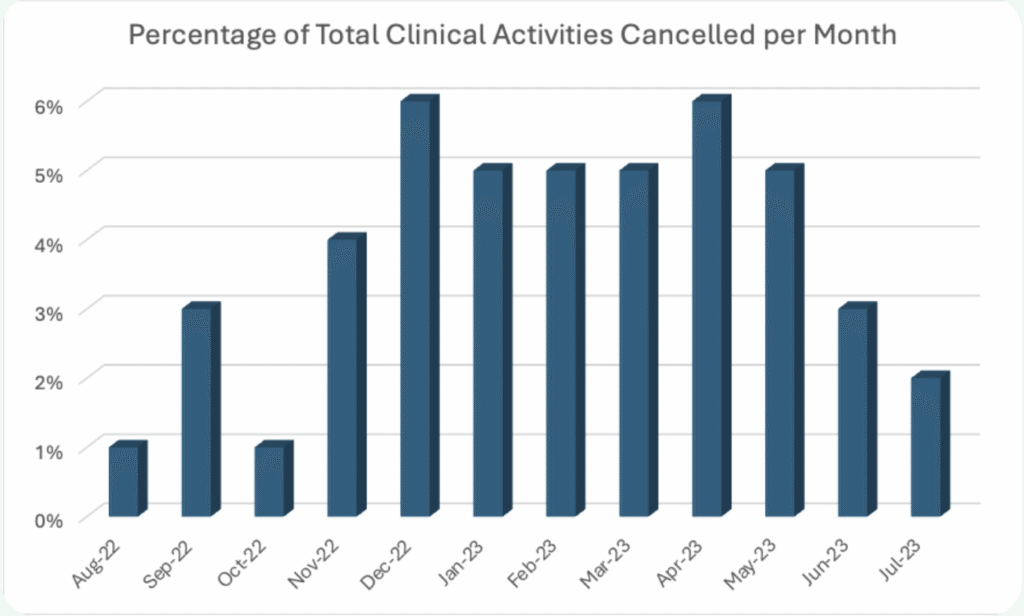
One of the key aims of any activity-based rostering project is to reduce theatre/clinic cancellations by using the solutions tools to spot and resolve gaps in activity ahead of time, allowing for optimum use of available resources. A review of the last 12 months of cancellation data demonstrates tangible evidence of grip and control of cancellation levels in clinical activities.
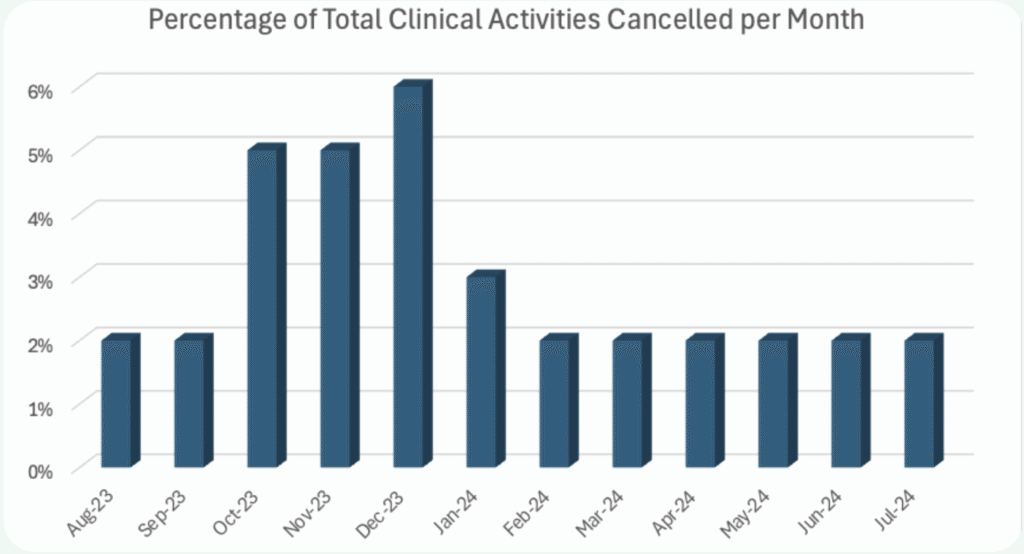
Compared to the previous 12 months, percentage of cancelled activities are now consistently at a level of 2% of total activity, despite the increase in rostered activity increase over the year.
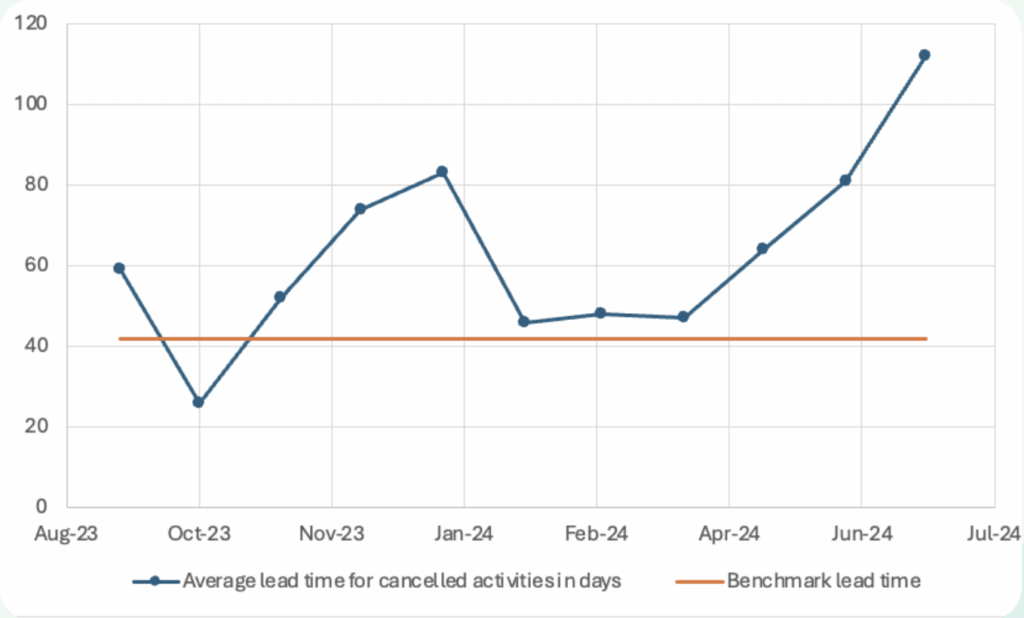
In addition further evidence supports the effective management of clinical schedules via the system, as the metric below show that the average lead time for cancelled activities has now increased well above the recommended 6 weeks (42 days) threshold. This means that the Trust is in a much stronger position to predict available theatre and clinic space ahead of time.