






EPR Data Migration
Continuity of care starts with continuity of information
Migrate the data that matters so your clinicians can make informed care decisions from day one. Derisk your EPR launch wtih accurate and complete data transfers, no matter how ambitious your digital transformation.
Bring the right data and workflows to the right place in your new EPR
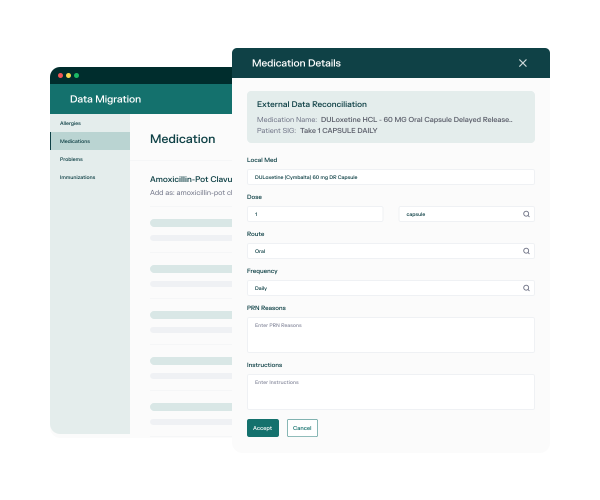
What data is moved, retained and deleted is a clinical continuity and operational decision. We move what clinicians need to deliver safe care from day one with confidence, cleaned, mapped to your new system’s language, and clinically validated before cut-over.
Whether you’re an NHS Trust, ICB, primary care network or private care provider, we ensure the integrity and accessibility of your data so you can focus on a succesful launch.
We’ve delivered some of the world’s most largest and most complex EPR migrations
300M
patient records migrated to date1,500+
completed migrations250+
source system extraction libraries
Reduce go-live risk
Reliable migration is critical to patient safety and successful launch
Deploying an EPR is a high risk endeavour. Missing, delayed or incorrectly recorded patient information can lead to serious harm and also disrupt your entire timeline. Our proven solutions minimise disruption so your teams can stay focused on delivering high quality, digitally enabled care to patients.
Migrate what matters so your EPR is ready for day one
Minimise clinical disruption with structured discrete data that fits perfectly into your new EPR. We pre-populate and clinically validate medications, allergies, problems and history before cut-over, so the first patient encounter on your new EPR runs on a complete record, not a blank one.
Clinically validated
Multi-phase validation combines manual and AI-supported automated checks with clinician-led review, so migrated data is accurate and usable in real workflows.
Speaks your new system’s language
Legacy nomenclature is automatically aligned to clinical equivalents in Epic, Oracle Health (Cerner), MEDITECH, Nervecentre, System C and others.
Full data history and workflows
Clinicians view, filter and trend historical records alongside new entries to support informed care decisions.







The tools behind every migration
Twenty years of cutting-edge healthcare data engineering ensures your data is handled with the same care and attention that you give your patients.
Normalise, cleanse, and de-duplicate data so it can be mapped into the clinical and technical workflows of the target EPR. The platform has supported the migration of billions of clinical data points across large-scale transformation programmes.
AI trained on thousands of real-world healthcare data projects. SDA reverse-engineers each legacy system’s structure and maps it into the shared model.
HL7, CCD, PDF, scans, flat files, handwritten notes, APIs, database calls are structured and brought across while keeping full fidelity and provenance.

What to migrate?
A “migrate everything” approach inflates cost, timeline and risk.
Across 1,500+ successful migrations, we’ve built best practice guidelines, and work with you to scope your data against clinical and operational need, feasibility and appropriateness.
Our fully managed end-to-end service includes legacy data strategy support, programme management, extraction and evaluation, planning, mapping, testing, cut-over and post-go-live support, so you can be confident that the data you need at your fingertips will be accessible and actionable.
Fully managed, from extraction to go-live
And beyond it, including cut-over execution and catch-up loads, so nothing recorded during the transition window is lost
Evaluation of source data, refinement of project scope and extraction from legacy systems, including both discrete and non-discrete data loads into the target system.
Oversight of the migration project to ensure alignment with the EPR implementation. Responsibilities include scope management, coordination of key deliverables and adherence to timelines.
Mapping of clinical data, EPR nomenclature, systems configuration and execution.
Management of data delivery, development of validation scripts, preparation of end-user instructions and oversight of issue tracking and resolution.

Client Spotlight
Underpinning a Single Digital Patient Record for eight million patients in New South Wales, Australia
• 15 health districts
• 228 hospitals
• 600+ community centres
• 150 laboratories
• Hundreds of legacy systems
Billions of data points migrated into a single regional Epic record, with an intelligent clinical archive built it.
Testimonials
See what customers have to say about RLD



When downtime events occur, we want patients to trust that we can still provide the highest quality, digitally enabled care that our patients have come to expect across our network, and RLDatix empowers us to ensure that continuity of care with confidence.
Raphael Jaffrezic Group Transformation Director and Chief Information Officer
Blackrock Health
Exceeded my expectations … They didn’t just agree with us on everything. Instead, they helped us understand why we were making a choice and told us what would happen if we did certain things. RLDatix was a true.
Chief Information Officer
I have a huge level of trust in RLDatix. RLDatix is our preferred vendor for all of our conversions. We trust what they say and that they will select the correct method of converting things.
Director
We couldn’t ask for a better company to come to the table and help us figure things out. We have had difficulties with some other vendors. In some cases, RLDatix has helped guide us on how to interact with the other vendors to try to complete the migration.
Director
Learn about Galen Data Archiving
Preserve the complete record in an intelligent clinical archive, one click from your EPR — and safely switch off the legacy systems that held it
Latest Resource
Advancing NHS Legacy Information Management
NHS trusts are under increasing pressure to modernise legacy information management, ensuring compliance, interoperability, and readiness for AI-driven healthcare. This whitepaper presents a staged maturity model, adapted for the NHS, to guide trusts from fragmented, rigid legacy data practices to intelligent, cloud-native information management.
Read Now

FAQs
Learn how our healthcare data migration service supports EPR transitions.
RLDatix clinical data migration moves the right clinical data from legacy systems into your new EPR so clinicians have the core information they need inside the new workflow, without trying to migrate everything. Done properly, it reduces go-live risk by ensuring key patient context (for example, diagnoses, scheduling, meds, allergies and immunisations) is present and usable in the new system.
A common pressure point is when clinicians understandably say “we need everything migrated,” which is rarely financially or technically feasible. The RLDatix team, based on years of technical experience and thousands of successful projects, helps clinical, IT, and operational teams understand and scope what truly needs to be migrated to your new EPR and what can safely sit in a clinician-friendly integrated archive for rapid access.
A practical rule is: migrate what drives functionality and safe care in the new EPR, and archive what is primarily “for reference” (older notes, historic labs, prior imaging reports, etc.). This reduces migration scope, timeline and stress without losing clinical, legal, reporting or analytics value as the full history remains available through the archive.
Our experience has shown us the most successful and EPR-prepared organisations are those who start thinking about migration before they select a new EPR vendor and engage a migration/archiving partner as soon as the vendor is selected (or even during final selection). Teams become fully occupied implementing the new EPR for months at a time, and preparing your data migration strategy early sets you up for success, and gives you the time needed to work with IT, clinicians and legal stakeholders.
Deploying a new EPR across your Trust, network or health system is one of the highest risk exercises you can undertake as an organisation. Poorly planned or partial migration creates real patient safety and operational consequences. Clinicians worry they won’t have what they need at the point of care, and data issues can quickly lead to operational and compliance concerns. RLDatix approach is to reduce those risks by scoping and executing a robust migration plan as part of the overall transition, not as an afterthought.
Legacy EPR data is often inconsistent across systems and time, and migration typically requires normalisation and data cleansing to fit the new EPR safely. RLDatix uses deep experience, an expert team, plus automation and AI where it safely helps, e.g., mapping “human descriptions” of similar items like lab panels across systems, to shorten migration effort, de-duplicate records, identify the authoritative data set, and reduce avoidable errors.
RLDatix can extract and transform data from a wide array of NHS legacy platforms, from core patient administration (PAS) to specialty and departmental systems, so you can migrate what matters into your new EPR and archive the full clinical record for access and retention.
Typical extraction sources include PAS (e.g., iPM/OASIS/Sunrise/PatientCentre), EPR/clinical systems (e.g., Lorenzo, MEDITECH, Cerner Millennium, SystemC), ED, maternity (BadgerNet, Euroking), theatres, ICU, cardiology, oncology, radiology/RIS, PACS, pathology/LIMS, order comms/results, EDMS/document management, and community/mental health platforms (e.g., RiO, Paris), plus other specialty systems.
Whatever your new EPR vendor, we’ll be able to map and migrate your data to your new EPR’s specific nomenclature. Our archive can be integrated into any modern EPR, so whether your moving to EPIC, Oracle/Cerner, Meditech, Nervecentre, TPP or EMIS, RLDatix will be able to support your transition and launch.
On the content side, RLDatix can handle the reality of “mixed” clinical records, not just neatly structured tables. That includes:
- Structured clinical data (demographics, encounters, orders, results, meds, allergies, problems)
- Clinical terminology and coding (e.g., SNOMED CT / local code sets, where present)
- Documents and correspondence (letters, reports, PDFs, rich text, text summaries)
- Images and scanned files (including scanned paper records)
- Handwritten notes captured as scans/images
- Workflow-related artefacts where they exist in source systems (e.g., forms, templates, departmental workflows)
This breadth is important because EPR transition success depends on both getting the right structured data into the new workflow, and ensuring the rest of the history remains searchable and usable in an archive without needing to keep the old systems running.
Not always – but in most EPR transitions they work best as a single strategy: migrate what the new EPR needs to function, and archive everything else for seamless clinical access. In our experience, it’s best that they go hand-in-hand so that there is never any scenario where someone needs something and doesn’t have it, during transition and after go-live.
Yes. RLDatix has supported over 1,500 migration and archiving projects, including some of the most complex and ambitious EPR deployments. That repeatable experience is critical because robust clinical migrations have many failure points when organisations try to do it alone or without partners with deep understanding of the process, vendor mapping and nuance of specific EPR platforms.
You’ll sometimes hear the platform referred to as Galen. RLDatix acquired Galen Healthcare Solutions (“Galen”) in 2023 and as a name synonymous with industry leading data solutions, and as such it is still occasionally used in conversations. Galen VitalCenterOnline (VCO), and GalenExtractTransformLoad (ETL) are product names used previously and still used in some other regions in which RLDatix operates.
Book a Demo
See why RLDatix is a trusted partner for more than 10,000 organisations around the world.