


Interactive Workshops: How Customers Used AI to Build Workforce Dashboards and Hospice Leaders Confronted the Staffing Crisis Head On
Introduction
Not every session at the Connected Health & Care Summit 2026 was a speaker on a stage. Five sessions were designed as interactive workshops and peer discussions, structured around participation rather than broadcast. These sessions were not recorded. There is no video or transcript. They were built for real-time collaboration: customers working in small groups, prototyping with AI, comparing approaches and giving direct feedback. Four used vibe coding to build workforce dashboards for medics rostering, temporary staffing, job planning and nursing. One brought hospice leaders together for a candid roundtable on a sector where the workforce and funding pressures facing the sector.
AI Accelerator: Vibe-Code Lab, Medics Rostering
Led by Katie Milligan | Activity Intelligence Challenge
This workshop asked attendees to design the workforce dashboard they wish they had. No coding experience was necessary. The goal was to use AI to build a prototype and present the idea.
The session started from a simple question: how do you report on Activity Manager productivity, engagement and ROI? Rather than asking what data is needed, it moved to prototyping the intelligence insights that transform reporting could make workforce and activity reporting more useful for decision-making.
Attendees worked through a structured four-step process:
- Step 1: Persona. Each group chose a target user: executives, service managers, medical directors, workforce or HR leads, clinical performance or operational roles
- Step 2: Vision. Create an NHS-ready, insight-driven Activity Manager dashboard that transforms workforce and activity data into clear, actionable intelligence, helping healthcare leaders make faster, evidence-based decisions that improve workforce utilisation, service stability and patient care
- Step 3: Objective. Groups selected from objectives including productivity gains, fill rate, workforce utilisation, reducing waiting times, reducing cancellations, reducing agency spend, increasing adoption, improving work-life balance and improving service stability
- Step 4: Challenge. Push the AI. It will not create the best version first time. Attendees were prompted to make dashboards less cluttered, prioritise the three most important KPIs above the fold, add AI-generated recommendations and make it feel like software a medical director would use every morning
The metric library covered six categories: activity and planning (planned vs actual, assigned vs unassigned, future capacity), workforce (fill rate, missing skills, grade mix, team coverage), performance (cancellations, cancellation reasons, publish lead time), adoption and ROI (active users, time saved, feature adoption), contractual (PA balance, flexi balance, exception indicators) and AI insights (risk score, predicted fill risk, AI recommendations).
Lovable the vibe-coding platform, can build the interface, but it cannot know what matters in your organisation. The session demonstrated why defining the user, objectives and metrics is an important part of building useful AI-enabled prototypes.
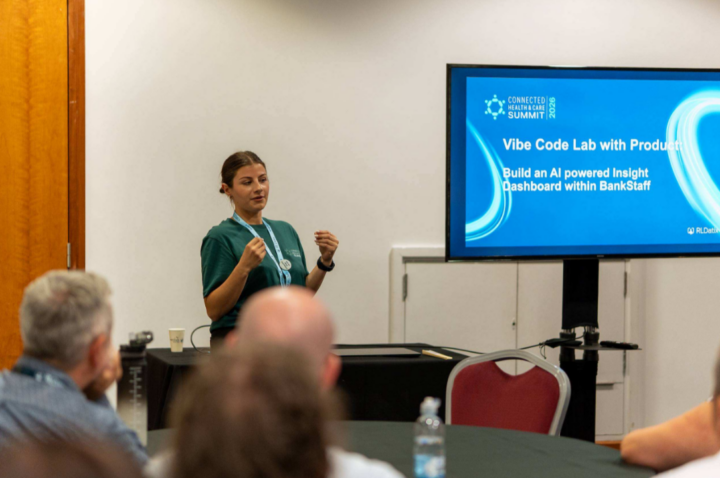
AI Accelerator: Vibe-Code Lab, BankStaff
Led by Richard Kitchen and Corinne Hall | Design a Temporary Staffing Insights Dashboard
This session followed the same vibe-coding format, asking attendees to design a temporary staffing workforce dashboard using AI-powered prompts to create workforce insights around trends, ROI and risk mitigation. The framing question was the same: how do you report on overall productivity, engagement and ROI? The session explored how AI could move reporting towards decision support. Rather than asking what data is needed, the session prototyped intelligence insights that transform reporting and success metrics.
The four-step process mirrored the Medics Rostering session but with temporary staffing-specific content:
- Productivity and engagement metrics covered overall fill rates, planned vs actual, bank utilisation, expiring certifications and available skills
- ROI metrics included bank vs agency comparisons, efficiency and time savings, time to fill trends by unit, skill or grade, and feature-specific return on investment such as Smart Match
- Decision support focused on recommended next actions, AI-surfaced risks, trend analysis and data-backed decision-making
- Objectives included increasing fill rate, workforce utilisation, reducing cancellations, reducing agency spend, improving work-life balance and improving service stability and continuity of care
An example prompt from the session demonstrated an Ask Assistant use case: creating a saved insight of medics staff with expiring certificates, showing the next 30 days plus already expired, with listed data and visual graph, a low, mid and high risk assessment based on skill vs possible impact to fill, and the ability to notify the bank office with a pre-populated email highlighting risks.
Metric categories covered planning (filled vs unfilled, bank vs agency, cancellations, time to fill lead time), workforce (fill rate, missing skills, compliance risks), adoption and ROI (active bank workers, time saved, feature-specific trends like Smart Match) and AI insights (risk score, AI-powered predictions and recommendations).
AI Accelerator: Vibe-Code Lab, JobPlan and Appraisal
Led by Tom Bird | Smarter Dashboards for Planning, Appraisal and Revalidation
This session applied the same vibe coding approach to job planning and appraisal, asking attendees to design the dashboard they wish they had for planning and revalidation. The framing question was: how do you report on JobPlan and Appraisal compliance and key KPIs? The session prototyped intelligence insights that could support reporting and decision-making around job planning and revalidation.
The personas and objectives were tailored to the job planning audience:
- Personas included executives, medical directors, responsible officers, appraisal leads, medical workforce and HR leads and clinical directors
- Vision. Create an NHS-ready, insight-driven Job Planning and Revalidation dashboard that transforms job plan and appraisal data into clear, actionable intelligence, helping healthcare leaders make faster, evidence-based decisions that improve job plan quality, appraisal compliance and revalidation readiness
- Objectives covered job plan completion, appraisal compliance, revalidation readiness, meeting key deadlines, DCC and SPA balance, reducing admin burden, increasing adoption, engaging consultants and governance assurance
- Challenge. Push AI. It will not create the best version first time. Make the dashboard less cluttered, prioritise the three most important KPIs above the fold, add AI-generated recommendations and make it feel like software a responsible officer would use every morning
Metrics spanned six categories: job planning (total job plans, signed vs unsigned, planned vs contracted PAs, DCC vs SPA split, job plan by specialty), appraisal and revalidation (appraisal completion, appraisals overdue, revalidation due, sign-off status, ARCP outcomes), compliance and quality (on-time completion, outstanding actions, compliance trend, directorate comparison), adoption and ROI (active users, time saved, feature adoption), contractual (PA balance, SPA balance, additional duties, exception indicators) and AI insights (risk score, predicted non-compliance, AI recommendations).
AI Accelerator: How AI is Transforming the Optima Unit Summary Page
Led by Jess Beardmore | Interactive Workforce Management Workshop
This was a fast-paced, interactive session exploring how AI-assisted tools could be used to help articulate operational challenges and explore potential solutions. Working in teams, participants used vibe coding techniques to address a nursing workforce scenario and build potential solutions in real time. Groups compared approaches to see how different perspectives influence outcomes and how collaborative innovation is helping shape the future of workforce management.
Transforming Workforce Management in Hospice Care
Led by Kirsty Edwards | Roundtable Discussion
This session took a different format from the AI Accelerator workshops. It was a structured roundtable discussion, not a vibe coding exercise. The focus was workforce management in hospice settings: challenges, opportunities and the future workforce.
The session opened with three quotes that framed the scale of a crisis: “nearly six in ten English hospices have made or are considering cuts to frontline services”; “hospices cannot fundraise their way out of this crisis because skydiving will not save them”; and “desperately needed hospice beds are shut as hospices can’t afford to staff them.”
The format was three big questions, seven minutes discussion each, followed by feedback and conversation.
Question 1: What feels most different about hospice workforce and demand compared with five years ago? Discussion areas included workforce shortages, increased competition for staff, financial pressures, changing workforce expectations, staff wellbeing, flexible working and growing complexity of care.
Question 2: Where are the key workforce pressure points and why? Discussion covered inpatient, community, hospice-at-home and role-specific pressures including specialist nurses, medical cover, children’s palliative care, community teams and admin and coordination roles.
Question 3: Which workforce decisions are hardest to make, and do you have the right data to drive the right action? Discussion areas included base staffing level setting, headroom setting, redeployment, skill mix, leave management, escalation staffing levels and use of temporary staffing.
The session closed with a final reflection: what would you do differently today if you had a clearer view of workforce pressure before it became a crisis and space to act?
Watch back sessions from Connected Health & Care Summit 2026.
Frequently asked questions
These five sessions were designed as interactive workshops and peer discussions, not presentations. They were structured around real-time participation, group exercises and direct feedback.
Vibe coding is an approach to building software prototypes using natural language prompts and AI rather than traditional programming. In these sessions, attendees described what they wanted a dashboard to show, and the AI tool generated interactive concepts in real time. Iterative refinement through better prompts produced progressively refined prototypes. No coding skills were required.
Lovable is an AI-powered application prototyping platform used in the AI Accelerator sessions. It generates interactive dashboard concepts from natural language prompts. Attendees described their target user, business objective and key metrics, and Lovable produced interactive visual prototypes.
Each session provided a library of suggested metrics tailored to the product area. Medics Rostering covered activity planning, fill rates, PA and flexi balance, and predicted fill risk. BankStaff covered bank vs agency fill, time to fill, Smart Match trends and expiring certifications. JobPlan and Appraisal covered signed vs unsigned plans, DCC vs SPA split, appraisal completion, revalidation due dates and predicted non-compliance.
The Medics Rostering Vibe-Code Lab was led by Katie Milligan. The BankStaff Vibe-Code Lab was led by Richard Kitchen and Corinne Hall. The JobPlan and Appraisal session was led by Tom Bird. The Hospice roundtable was led by Kirsty Edwards. The facilitator for the Optima Unit Summary Page session was led by Jess Beardmore.
The discussion was built around three questions designed to move from understanding the changing workforce landscape to identifying where action is needed:
- What feels most different about hospice workforce and demand compared with five years ago? Participants explored changing workforce expectations, shortages, competition for staff, financial pressures, wellbeing and the increasing complexity of care.
- Where are the key workforce pressure points and why? The conversation looked across inpatient, community, hospice at home and specialist roles, including nursing, medical cover, children’s palliative care, community teams and coordination.
- Which workforce decisions are hardest to make and do you have the right data to drive the right action? Participants considered decisions around staffing levels, headroom, redeployment, skill mix, leave management, escalation staffing and temporary staffing.