


Learning from data across NHS Wales: what Formula One can teach us about proactive safety
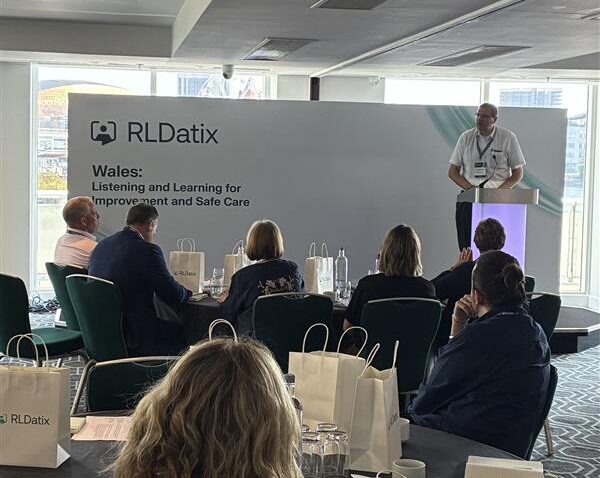
Insights from Gethin Bateman, Digital Health and Care Wales, recorded at the RLDatix Wales: Listening and Learning for Improvement and Safe Care event, 23 June 2026, St. David’s Cardiff
Healthcare has always been good at investigating what went wrong. What it has been less good at is anticipating what might go wrong next. Gethin Bateman, a paramedic by background with 16 years in patient safety at Digital Health and Care Wales, used an unexpected lens to challenge the room: Formula One. His argument was direct, and it built on every session that came before it.
Key takeaways from this session
- Healthcare is good at understanding what went wrong. It is less good at anticipating what might go wrong next. The shift from reactive to proactive safety is the central challenge.
- A single incident doesn’t tell you much. Patterns tell the story. What matters is how we aggregate data, recognise trends over time and act on them before harm occurs.
- DCIQ is NHS Wales’s frontline telemetry system. It captures incidents, near misses, harm events and emerging risks, but its real power is in pattern recognition across the whole system.
- No single data set tells the whole story. Triangulating incidents with complaints, audit findings, patient feedback and workforce signals is what turns data from descriptive into predictive.
- Staff knowledge is a data source too. Frontline teams know more about what works and what doesn’t than any incident report will ever capture. We miss a trick by not engaging with that knowledge more fully.
The Formula One analogy
How high-performing systems prevent failure before it happens
In Formula One, everything operates on the edge of failure. It is a highly complex environment, high pressure, high speed, high stakes. Every car generates millions of data points per race: engine performance, tyre degradation, fuel load, aerodynamics, driver inputs, driver welfare. All of it is constantly monitored.
That, Gethin argued, sounds very familiar.
"The data isn’t collected through reporting. It’s used in real time to prevent failure.”
Gethin Bateman, Digital Health and Care Wales
The cost of failure in Formula One is not simply losing a race. It is catastrophic: significant financial cost, loss of confidence, reputational damage and, in the worst cases, serious harm or death. The entire system is designed to detect risk early, interpret patterns in the data and act immediately.
The pit wall crew are making real-time decisions based on multiple data streams simultaneously. Those decisions are never based on a single data point. They are based on trends, collective patterns and context, interpreted by experienced staff who are constantly asking: what is the risk right now, and what might happen next?
"They’re not waiting for failure to confirm there’s a risk. They’re acting upon it in advance.”
The problem with reactive safety
We analyse incidents in isolation and focus on compliance over learning
Healthcare’s safety systems, by contrast, are largely reactive. They are incident-driven, focused on what has already happened. We collect lots of data: incident reports, complaints, patient feedback, audit findings, never events. But we tend to analyse them in isolation, focusing on whether the investigation was completed, whether the target was met, whether the case was closed in time.
"We don’t always translate that available data into actionable insight that allows us forward-looking risk intelligence. We’ve got lots of data, but our challenge is what do we do with it.”
Gethin noted that the NHS Wales National Patient Safety Plan recognises this directly. It acknowledges that current systems are fragmented, reactive and focused on compliance over learning. It calls for a shift toward system-wide learning, proactive risk assessment and continuous improvement.
The plan draws a critical distinction that aligned exactly with the Formula One analogy: performance data tells us what has already happened. Safety is about anticipating what happens next.
DCIQ as frontline telemetry
A single incident doesn’t tell you much. Patterns tell the story.
Gethin reframed DCIQ by RLDatix, the Once for Wales Concerns Management System, as NHS Wales’s equivalent of a Formula One telemetry system. It captures incidents, near misses, harm events and emerging risks across the whole system.
But just like Formula One, a single data point is almost irrelevant. What matters is how that data is aggregated and whether patterns are recognised.
"A single Datix incident doesn’t tell you very much. What matters is how we aggregate that data and how we recognise patterns.”
He used a medication example to illustrate the point. A handful of low-harm medication errors across different wards, picked up through Datix, might highlight a system design issue, a training gap or a digital usability problem. Individually, none of them looks alarming. Collectively, they tell a story.
"That’s where data becomes safety intelligence. By looking at all of those incidents grouped together, we see where the issue lies.”
Triangulating signals across the system
No single data set tells the whole story
The real shift happens when incident data is combined with other sources. Gethin walked through how the medication example changes when you add in complaints about discharge medication, audit data showing variation in prescribing and patient experience feedback. What started as a few low-level incidents on individual wards becomes a clear picture of system-level risk.
"That’s when data moves away from being descriptive to being predictive and preventative. Multiple data streams, interpreted as patterns, acted upon early. It’s exactly the same way telemetry works in Formula One.”
The patient safety plan calls for exactly this: using real-time data, multiple data sources and triangulated signals. No single data set tells the whole story. But when you combine incident data with complaints, audit, outcomes, workforce signals and, crucially, the knowledge and experience of frontline staff, you start to see risk before it becomes harm.
Staff knowledge matters as much as system data
Gethin made a point that cut through the technical discussion. Frontline teams are themselves a critical data source, one that is often underused.
"Some of my staff know far more about what doesn’t work well, and what does work well, than any incident report will tell me. I think we miss a trick by not engaging with our staff more fully.”
He drew the parallel back to the pit wall: experienced engineers don’t just rely on the computer. They interpret data through the lens of their own knowledge and context. That combination of data, experience and judgement is what turns information into action.
Wales’s opportunity
Don’t replicate, build something better
Gethin looked across the border at England’s systems. The National Reporting and Learning System (NRLS) and its successor, Learning from Patient Safety Events (LFPSE), allow for detection of national trends, identification of emerging themes and the development of patient safety alerts. When local patterns are aggregated nationally, risks that would be invisible within a single organisation become clear in the system-wide picture.
Wales does not currently have a direct equivalent. But Gethin saw that as an opportunity, not a gap.
"What we need in Wales isn’t necessarily to replicate the NRLS and the LFPSE. We take the opportunity to work collectively and collaboratively to build something more integrated, more intelligent, where we combine our incident data, our patient experience, our audit and outcomes, our workforce signals, and our knowledge and experience.”
The infrastructure is already there. DCIQ captures approximately 150,000 records a year across the whole of NHS Wales. The patient safety plan provides strategic direction. The collaborative culture of the Welsh system creates conditions for sharing that other nations are still working toward.
The question is whether Wales can move from isolated signals and localised learning to a genuine national safety intelligence system, one that sees risk early, understands it collectively and acts on it at scale.
The common thread
"Formula One teams don’t wait for failure to learn, and neither should we.”
The opportunity in front of NHS Wales is not to collect more data. It is to become a system that sees risk early, triangulates signals from multiple sources, values the knowledge and experience of its staff, and learns at scale. That is what prevents harm. That is what safe systems do.
Continue the Conversation
Proactive safety depends on identifying risks before harm occurs. The ability to connect data, uncover patterns and act on emerging signals is becoming increasingly important across healthcare.
Related Summit sessions:
- Data, Intelligence and Leadership: Why NHS Boards Need Analysts at the Table
- From Benchmarking to Action: How RLDatix Is Using AI and Data Intelligence to Raise the Standard of Care
- Missing the Signs: How to Trust Data, Dashboards and People. Part One
Learn how healthcare leaders are using data, analytics and intelligence to support safer, more proactive decision-making.
FAQs
Formula One operates in a high-pressure, high-complexity environment where the cost of failure can be catastrophic, including serious harm and death. Every car generates millions of data points per race, and the entire system is designed to detect risk early, interpret patterns and act before failure occurs. Healthcare operates under similar pressures but has traditionally relied on reactive, incident-driven safety systems rather than the proactive, real-time approach that characterises Formula One.
DCIQ is the Once for Wales Concerns Management System, powered by RLDatix. It is the shared platform through which all NHS Wales organisations capture incidents, near misses, complaints, claims, mortality reviews and other safety-related data. With approximately 150,000 records captured each year, it provides the foundation for pattern recognition and system-wide learning across Wales.
Triangulation means combining data from multiple sources to build a fuller picture of risk. Rather than relying solely on incident reports, organisations can combine that data with complaints, patient feedback, audit findings, workforce signals and staff knowledge to identify patterns that no single data set would reveal on its own. When these signals are triangulated, data moves from being descriptive (what happened) to predictive (what might happen next).
Reactive safety focuses on investigating what has already gone wrong: reviewing incidents, closing cases, meeting compliance targets. Proactive safety focuses on anticipating what might go wrong next by monitoring trends, recognising emerging patterns and intervening before harm occurs. The NHS Wales National Patient Safety Plan explicitly calls for this shift, distinguishing between performance data (what has happened) and safety intelligence (what might happen next).
Wales does not currently have a direct equivalent of England’s Learning from Patient Safety Events (LFPSE) system. However, DCIQ provides a shared national platform across all NHS Wales organisations, and the new patient safety plan calls for integrated data systems, triangulation of multiple data sources and a connected national learning system. Gethin argued that this is an opportunity to build something more integrated and intelligent than replicating existing models from other nations.