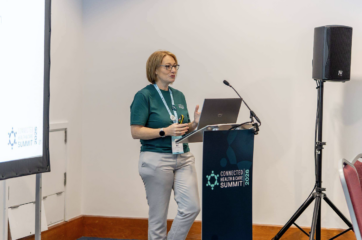


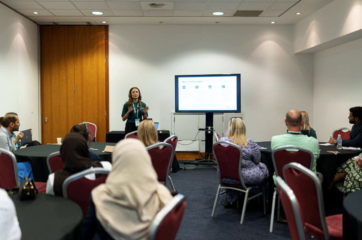
Psychological Safety and Incident Reporting
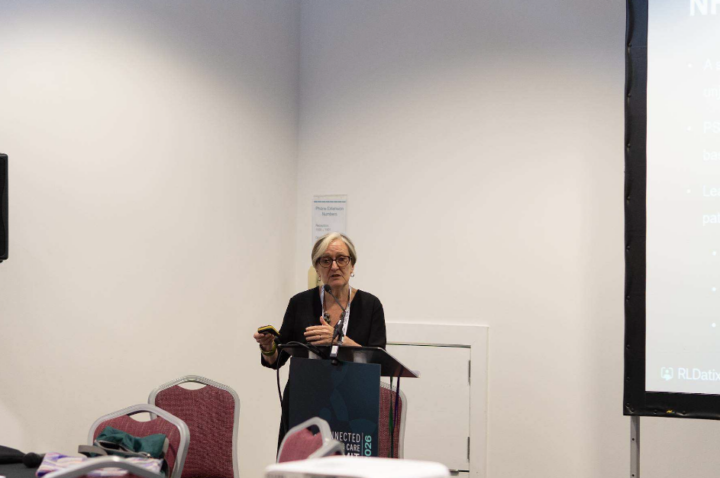
The national reporting and learning system holds over 20 million incident reports. Helen Hughes argues that much of the data is not sufficiently accessible, analysed or shared back. In this session from the Connected Health & Care Summit 2026, Helen Hughes, Chief Executive of Patient Safety Learning and the original Senior Responsible Officer for designing the National Reporting and Learning System, connects psychological safety to incident reporting and asks why we are collecting data without producing enough learning or safer care. She introduces two academic models, the Orange Wire Test, and an AI-generated self-assessment framework that she built using Perplexity shortly before the summit.
Watch Helen Hughes explain why incident reporting only works when it is psychologically safe, why the NHS has not yet passed the Orange Wire Test, and how an AI tool helped her build a self-assessment framework in a week.
What the session covers and the central argument
This session connects two topics that are rarely combined: psychological safety and the mechanics of incident reporting. The central arguments and perspectives were:
- Psychological safety is not a cultural extra. Helen Hughes argues when it is absent, organisations are less able to identify and learn from avoidable harm.
- The NRLS was designed as a learning system but became a data collection system. The feedback loop on learning and applying that learning does not execute effectively
- Over 20 million incidents are reported nationally but the data is not accessible, analysed or shared. The room confirmed nobody could get hold of it
- An aviation reporting system in New Zealand collapsed the day confidentiality was broken by sharing one report with regulators. Nobody reported again
- The Orange Wire Test, created by Sir Liam Donaldson, asks whether a hazard spotted in one place can travel across the system fast enough for someone to recognise a pattern and act. Helen Hughes states the NHS has not yet passed this test
- Staff disengage from reporting when feedback is delayed or absent. If you do not go back to the reporter, they stop reporting
The models, the gap between policy and practice, and what needs to change
Helen Hughes presents two academic models. Amy Edmondson’s four zones of team performance show the interaction between psychological safety and accountability. High safety but low accountability creates a comfort zone. Low safety and high accountability creates the anxiety zone where Helen Hughes says many NHS staff feel they sit. Tim Clark’s staged progression moves from inclusion through learner safety and contributor safety to challenger safety, where staff feel confident challenging the status quo.
She illustrates the gap between work as imagined and work as done with a case from King’s College Hospital, where an investigator found 31 policies governing mental health patients in ED. Most staff did not know they existed and one required a specialist consultant within two hours from a service that only ran Monday to Friday. Helen Hughes uses the example to illustrate how policies can become disconnected from operational reality, leaving staff and patients vulnerable when something goes wrong.
What this means for organisations and who it is relevant to
Helen Hughes identifies the conditions required for learning: visible leadership support, compassionate responses, timely feedback, accessible reporting systems, protected time for team reflection, and mechanisms for sharing learning across organisations. She notes that investigation findings from PSIRF are now being shared through patient safety networks with permission from chief nurses and legal teams, which she describes as culturally significant, but adds that it should not need a charity to make this happen.
She introduces a self-assessment framework generated using Perplexity that measures psychological safety across four behavioural domains: vulnerability role modelling by leaders, non-punitive reporting maturity, open feedback forums, and participation in safety huddles. A maturity scale runs from absent through emerging and developing to established. She connects this to Patient Safety Learning’s broader “what good looks like” framework covering six core foundations.
Her closing point: Helen Hughes argues that boards need to define what they are trying to achieve, assess their baseline, identify gaps, design an improvement plan, and evidence impact. Work with Great Ormond Street and Barts Health NHS Trust is using this approach.
This session is relevant to patient safety leads, governance teams, chief nurses, medical directors, incident reporting managers, Datix administrators, quality improvement teams and anyone responsible for psychological safety, speaking up or learning from harm.
Frequently asked questions
The session is presented by Helen Hughes, Chief Executive of Patient Safety Learning, who was the Senior Responsible Officer for designing the National Reporting and Learning System at the National Patient Safety Agency. She is also President Elect for the Patient Safety section of the Royal Society of Medicine and previously helped set up the WHO global patient safety programme. She is introduced by Product Director Mark Linggood from RLDatix.
Helen Hughes argues psychological safety is a core condition for learning. If staff do not feel safe to report, the system cannot learn effectively. She cites an aviation reporting system in New Zealand effectively failed the day confidentiality was broken. She also describes situations where NHS staff who raise concerns may feel ignored, shut down or unsupported, reinforcing the belief among others that it is safer to keep discreet.
Created by Sir Liam Donaldson in the early 2000’s, the Orange Wire Test asks whether a safety hazard reported in one place can inform the system so that someone can recognise a pattern and act. Helen Hughes argues the NHS has not yet passed this test. She illustrates the idea by contrasting how a report might fail to travel between organisations or regions, using examples such as Dubai and Oman or Grimsby and Brighton.
Amy Edmondson’s four zones of team performance map the interaction between psychological safety and accountability. High safety plus high accountability produces the learning zone. High accountability plus low safety produces the anxiety zone that Helen Hughes states where many NHS staff say they sit. Tim Clark’s staged model progresses from inclusion safety through learner safety and contributor safety to challenger safety. Together, the models provide different ways of understanding team climate, psychological safety and progression.
Helen Hughes used Perplexity to generate a psychological safety self-assessment framework. It measures four behavioural domains: vulnerability role modelling by leaders, non-punitive reporting maturity, open feedback forums and participation in safety huddles. A maturity scale runs from absent through emerging and developing to established. Helen Hughes describes it as aligned with Patient Safety Learning’s broader “what good looks like” framework.
Helen Hughes identifies delayed or absent feedback as the most significant barrier to sustained reporting. If reporters do not hear what happened with their report, they disengage. Even when organisations conduct thematic reviews, if they do not go back to the original reporter, that reporter has no reason to continue. During COVID, Helen Hughes argues that reporting was suspended or significantly disrupted in some areas, reducing frontline insight on issues such as PPE and capacity.
Helen Hughes describes early conversations between Patient Safety Learning and Datix about thematic reviews and sharing learning from investigations across organisations. She notes that investigation findings are not collated or shared in the way they should be in a learning system. She argues there should be more that can be done together, particularly in closing the loop between reporting, learning and improvement.