

What it really means to be a learning system for patient safety
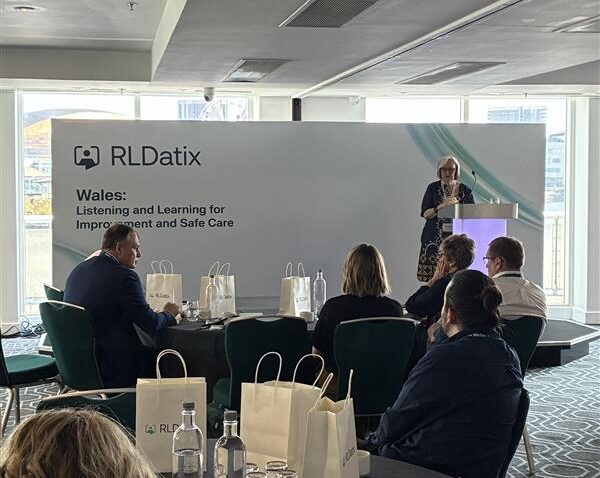
Insights from Helen Hughes, Chief Executive of Patient Safety Learning, recorded at the RLDatix Wales: Listening and Learning for Improvement and Safe Care event, 23 June 2026, St. David’s Cardiff
Healthcare has spent 25 years collecting safety data, publishing reports and building frameworks. What it still struggles with is turning that knowledge into sustained, system-wide change. Helen Hughes, Chief Executive of Patient Safety Learning, brought that challenge into sharp focus in her keynote at the RLDatix Wales event, drawing on national and international experience to ask what it would really take to build a genuine learning system across NHS Wales.
Key takeaways from this session
- Think system, not just organisation. Individual organisations learning in isolation is not enough. Wales’s collaborative culture gives it a real opportunity to design learning into the whole system.
- Close the implementation gap. Understanding why previous recommendations weren’t implemented matters more than writing the next report.
- Be explicit about learning. Very few health organisations have a dedicated learning strategy. Learning is assumed, not designed.
- Boards should be stewards of improvement capability, not just performance overseers. Curious boards ask whether the foundations for safer care are in place, not simply whether cases have been closed.
- Safety is a social movement. It requires empowering people, celebrating what works and sharing learning openly across boundaries.
The scale of the challenge
Why 25 years of data collection has not been enough
In high-income countries, one in 10 patients is harmed during care, and half of that harm is preventable. It is one of the top 10 leading causes of death and disability worldwide. OECD data shows that 15% of all healthcare costs are attributable to unsafe care. When the UK’s national strategy was developed in 2019, it estimated 11,000 avoidable deaths per year in England alone.
"That’s two jumbo jet crashes a fortnight killing people, which is a shocking figure. It’s gone up since then. We’ve had COVID, we’ve got stress on the system.”
Helen Hughes, Chief Executive, Patient Safety Learning
Helen argued that the health system has unintentionally normalised this level of risk, and that the response mechanisms put in place over the past quarter century have not delivered what they were designed to produce.
"We thought that by amplifying those risks and collecting the data, we would learn from it, deploy that knowledge and make the change. And that we wouldn’t be having the same conversation 25 years later.”
Why does harm persist? Safety is treated as one priority among many. Cultures of blame suppress voices. And leadership too often delegates safety to a senior clinician rather than treating it as a whole-system responsibility requiring everyone from chairs and non-executives to politicians.
From learning organisation to learning system
Why Wales is well placed to lead, and why being explicit about learning matters
Helen was given the title “What does it mean to be a learning organisation?” She promptly reframed it.
"It’s not sufficient to look at things just as an organisation. It’s how you design the whole system.”
Learning is assumed, not designed
Very few health organisations have a dedicated learning strategy. Learning is treated as implicit within clinical governance, risk management or quality strategies, rather than something deliberately designed, resourced and monitored.
"Very few health organisations will have a learning strategy. They will just assume it’s something that is done. And drawing out learning is not always a top priority.”
The multidisciplinary team as a safety indicator
Helen highlighted that how well multidisciplinary teams work together is one of the most reliable predictors of safe, effective care. Yet the system seldom sets standards for team effectiveness or deliberately invests in developing it.
"Do we set standards for that? Do we monitor it? Do we nourish it? It’s kind of assumed it just happens.”
Wales’s opportunity
Wales has a structural advantage. Its scale, collaborative culture and established relationships across organisations create conditions for system-wide learning that other UK nations are still working toward.
"Wales has a fantastic opportunity because you’re a community, because you work very collaboratively. You’ve got the opportunity to do things system-wide.”
She referenced the new patient safety plan for Wales and challenged the room: the ambition is clear, but does it have a credible implementation pathway? And has Wales learned from where other nations have already hit bumps in the road?
Mind the implementation gap
Healthcare diagnoses the problem well. It struggles to deliver the cure.
Patient Safety Learning’s report, Mind the Implementation Gap, examined why national learning mechanisms repeatedly identify the same issues without driving sustained change. The failure lies not in the quality of recommendations, but in the organisational culture, capacity and commitment needed to deliver them.
"Why doesn’t someone look at why we weren’t able to implement the previous three reports, rather than just doing the fourth report that says the same thing?”
Work as imagined versus work as done
Helen drew a clear distinction between work as imagined, how senior leaders believe care is delivered, and work as done, the reality shaped by resources, competing demands and human factors. Solutions designed centrally don’t always translate on the ground.
"You could go and speak to frontline clinicians and they say, ‘Another policy and procedure on top of all the other policies and procedures? Really? Is that going to make it work?"
Healthcare is more complex than rocket science
She reinforced the point with a conversation with Jim Bagian, former Director of Patient Safety at the US Veterans Affairs system and a former NASA astronaut:
"Jim said, ‘Healthcare safety is much more complicated. Rocket science is easy. It’s chemistry, its physics, it’s predictable. But healthcare involves people, people interacting with systems, understanding human factors."
Safety science tools can help bridge the gap, but they cannot simply be lifted from other industries. Healthcare’s complexity demands they be adapted and tested with rigour.
Curious boards and the foundations for safer care
Moving from compliance to genuine curiosity about safety
Too often, Helen argued, boards operate in a mode of reassurance and compliance, receiving reports, checking deadlines and confirming cases are closed. That is not the same as understanding whether an organisation has the foundations for safer care.
"A curious board would be asking those kinds of questions, not just waiting to see the incident reports and whether you’ve closed the cases. It’s not just about the process. It’s the underlying curiosity, the culture, that drive for improvement.”
Don’t wait for the regulators
Organisations should know their own ambitions around safety, understand their baseline, and have an informed conversation with regulators about where they are on the journey, rather than waiting to be told whether they are safe.
Connected data enables self-awareness
"Partnering here with RLDatix is really important because you are a tremendous source of that data. But it’s not about looking at data in a siloed way. It’s being curious. What is this saying about our culture, our capacity to understand risk, our capacity to respond and make improvement?”
Stewards of improvement capability
Helen quoted George Findlay, a former NHS chief executive, whose framing she called “profound”:
"Boards should be stewards of improvement capability, not just performance overseers.”
That shift connects patient safety directly to the productivity agenda, because under enormous financial pressure, safety and quality are not competing priorities. They are core components of productivity in the round.
Safety as a social movement
Celebrating what works, sustaining what matters
Helen closed by reframing patient safety beyond processes and compliance. Safety, she argued, is part of a broader social movement, a shift in how health and care systems think about risk, learning and the role of every person within them.
Much of healthcare delivers very good, compassionate care, sometimes despite the systems around it. Learning from those successes deserves the same rigour applied to incident investigation.
"We need more structured ways of learning about when people do things very well and celebrate that.”
It also means making improvements sustainable, not running them as time-limited programmes that lose momentum when funding ends. Patient Safety Learning’s Hub, now the largest patient safety knowledge repository in the world with nearly four-million-page views, exists because that sharing didn’t happen at the scale needed through existing channels.
"Make patient safety improvements sustainable, not just one-hit wonders where the funding runs out and then you lose the input.”
The common thread
The challenge facing patient safety is not a shortage of insight. It is building systems that learn, act and sustain improvement, deliberately, not by assumption.
Wales is well positioned to lead. Its collaborative culture, its scale and its new patient safety plan set a clear direction. The question now is whether the ambition can be matched with the implementation discipline needed to make it real.
That work belongs to everyone.
Continue the Conversation
Creating a learning health system requires more than reacting to incidents. It depends on strong reporting cultures, effective learning processes and the ability to turn insights into meaningful improvement.
Related Summit sessions:
- Innovation in Learning: Collaboration Between PSIRF and Coroners
- Psychological Safety and Incident Reporting
- Learning from Claims Data: A Systems Approach to Improving Patient Safety
Explore these sessions to discover how healthcare organisations are strengthening learning systems, encouraging open reporting and transforming insight into safer care.
FAQs
Patient Safety Learning is an independent charity founded in 2018 to listen to, learn from and promote the voice of the patient safety frontline. It was deliberately established as a charity, independent of the NHS, so it could speak candidly about safety challenges. It operates the Hub, a free and award-winning learning platform that has become the largest patient safety knowledge repository in the world, and it hosts six free peer networks covering topics from patient safety management to surgical safety and education.
"Work as imagined” refers to how senior leaders and policymakers believe care is delivered: the policies, procedures and standards intended to be followed. “Work as done” is what actually happens on the frontline, shaped by real-world pressures including staffing, resources, competing demands and human factors. When these diverge significantly, well-intentioned recommendations can fail to change practice. Safety science tools, such as those outlined in the Patient Safety Incident Response Framework (PSIRF), can help organisations understand and bridge this gap.
The implementation gap describes the persistent pattern where reports, inquiries and frameworks identify the same safety issues and recommend the same changes, but those changes are not fully or sustainably implemented. Patient Safety Learning’s report, Mind the Implementation Gap, examined this pattern across coronial systems, clinical negligence schemes and public inquiries, finding that the failure often lies not in the recommendations themselves but in the organisational culture, capacity and leadership commitment needed to deliver them.
A safety management system is a structured, organisation-wide approach to managing safety that integrates leadership, governance, culture, data and improvement into a coordinated framework. Widely adopted in industries such as aviation, which has robust fatigue management approaches that healthcare largely lacks, the concept is increasingly being explored in health and care settings. Helen noted that healthcare’s complexity means these systems cannot simply be transferred from other industries but must be adapted to account for human factors and the unpredictability of clinical care.
The Hub is free to access at patientsafetylearning.org and contains learning resources, expert perspectives, case studies and practical tools. Patient Safety Learning also runs six free networks, including the Patient Safety Management Network with over 2,000 members, which meets weekly on Friday afternoons. All networks and Hub resources are open to health and care professionals across the UK and internationally.